
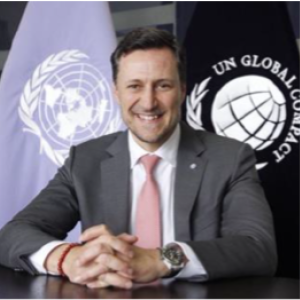
Speech of the UN Resident Coordinator in the Philippines for the Sustainability Summit
Beyond Commitments: Sustainability for Business Resilience
Partnerships for the Next Frontier of Sustainability
Good morning.
The theme of this Summit is exactly right: Beyond Commitments: Sustainability for Business Resilience.
Because today, the real question is no longer whether companies have sustainability commitments.
Most do.
The question is: do those commitments actually make businesses stronger, more competitive and better prepared for the next shock?
And I would start with one simple proposition:
No business can be resilient in an economy that is not resilient.
A company may strengthen its own operations, diversify suppliers, reduce emissions and manage risk. But if energy systems are fragile, skills are missing, inequality is rising or supply chains cannot withstand disruption, no company is fully protected.
That is why the next frontier of sustainability is partnership at scale — mobilizing capital, technology, skills and business capability to strengthen the wider economy on which long-term growth depends.
For the Philippines, this moment is particularly important.
In 2026, the country reached upper-middle-income status while also holding the ASEAN Chairship.
One reflects progress at home. The other gives the Philippines influence across the region.
But the real test of both will be what they leave behind: higher productivity, better jobs, stronger businesses and systems that are ready for the next shock.
And shocks will come.
We have seen it with pandemics, extreme weather, geopolitical tensions, energy prices and disrupted supply chains.
So resilience has to move from the risk register into the core business model.
Let me highlight three areas where I believe partnership can make the biggest difference.
First: invest in people as a resilience strategy.
The Philippines has a major competitive advantage: its people.
But part of that advantage remains underused.
Women in the Philippines have more years of schooling than men, yet labour-force participation remains only around 53.5 per cent, compared with 75.8 per cent for men.
That is a gap of roughly 5.6 million people.
This is not mainly a skills problem. It is about unequal pay, inflexible work, care responsibilities and barriers to advancement.
For business, that is not simply a social issue.
It is a talent issue.
Companies that offer flexible work, fair pay, childcare support and real pathways to leadership can access talent that their competitors are leaving behind.
And this matters even more as the country ages.
By 2055, the population aged 60 and above will more than double. That will create new demand for care, health, insurance, housing and services that save people time.
So the care economy is not only a social investment. It is an emerging market.
Closing gender gaps could significantly raise household incomes and create trillions of pesos in additional annual demand.
That is resilience: stronger families, deeper labour pools and larger domestic markets.
The same applies to children and young people, who make up nearly half of the Philippine population.
Their rights are still largely absent from corporate sustainability reporting.
But family-friendly workplaces, decent work for parents, safe products and responsible marketing are not just safeguards.
They improve productivity, strengthen talent retention and protect future demand.
Second: turn climate ambition into an investment agenda.
The Philippines' new NDC keeps the 75 per cent emissions-reduction and avoidance target for 2025 to 2035, while increasing the share expected to come primarily from domestic resources.
That is important because it signals stronger national ownership.
But the remaining share is also a very clear invitation to partnership.
The opportunity for business is not abstract.
It sits in energy efficiency, cleaner transport, greener construction, resilient infrastructure, circular production, sustainable agriculture and nature-based solutions.
In other words, the NDC is not just a climate document.
It can become an investment map.
The challenge now is to turn ambition into bankable projects.
That means policy clarity, better project pipelines, stronger institutions and earlier dialogue with investors.
Energy is an obvious example.
Recent disruptions around the Strait of Hormuz have reminded us just how quickly an external shock can affect fuel, freight, fertilizer, food and financing costs here in the Philippines.
For business, energy dependence is a competitiveness risk.
So cleaner energy is not only about decarbonization.
It is also about security, affordability and predictability.
And this is where ASEAN has an opportunity.
Countries across the region face many of the same vulnerabilities. That gives ASEAN a strong reason to cooperate on grids, clean energy investment, supply chains and energy security.
A just transition is also essential.
The Philippines' Global Accelerator roadmap is already connecting green investment with skills, social protection and enterprise upgrading, beginning in sectors such as transport and construction.
This matters because infrastructure projects do not succeed on capital alone.
If workers do not have the right skills, if smaller suppliers cannot adapt or if communities do not see the benefits, projects slow down and costs increase.
So workforce readiness and supplier readiness are not side programmes.
They are part of risk management.
Third: build resilience across the whole value chain.
The green and digital transitions will only succeed if Philippine firms — especially MSMEs — can participate.
Large firms can set ambitious standards.
But if their suppliers cannot finance new equipment, meet environmental standards, adopt digital tools or improve traceability, the entire value chain remains vulnerable.
This is where partnership becomes practical.
Business can provide long-term demand and supplier relationships.
Government can create the right enabling conditions.
Financial institutions can provide fit-for-purpose financing.
Technology companies can help firms upgrade.
And the UN can help connect technical expertise, standards, partners and international finance.
AI will increasingly be part of that story.
Used responsibly, it can improve productivity, quality control, energy management and traceability.
The ambition should not simply be for Philippine companies to compete in ASEAN supply chains.
It should be for Philippine companies to help shape the technologies, standards and value chains that will define ASEAN's future.
And this brings me back to the theme of today.
Beyond commitments.
So my ask to this room is simple:
Move sustainability from commitment to capability.
Invest in people.
Invest in clean and secure energy.
Invest in stronger suppliers and value chains.
And invest in partnerships that can deliver at scale.
Government creates the enabling environment.
Business brings capital, innovation and execution.
And the United Nations can help connect partners, expertise and finance around shared priorities.
If we get this right, resilience will not simply protect Philippine businesses from the next shock.
It can become a competitive advantage for the Philippines — and for ASEAN.
That, I believe, is the next frontier of sustainability.
Thank you. Maraming salamat po.



Speech by
Goals we are supporting through this initiative

